-
Your Data Architecture Strategy Is Probably Failing — Here’s How to Diagnose It and Fix It
What a Data Architecture Strategy Actually Needs to Do (Not Just What It Is) Most companies don’t struggle because they lack tools. They struggle because their data architecture doesn’t behave like a system. On paper, everything looks right: cloud warehouse, dashboards, pipelines, maybe even governance initiatives. But in practice, the architecture isn’t enabling decisions—it’s just…
-
Do You Really Have a Data Enablement Strategy — or Just More Data No One Uses?
The real problem: you have data, but not decisions Most organizations don’t have a data problem. They have a decision problem. They’ve invested in dashboards. Built data lakes. Rolled out BI tools. Hired analysts. Migrated to the cloud. And yet—nothing fundamentally changes. Decisions still happen in meetings driven by opinion. Reporting is still manual. Teams…
-
Why Your Modern Data Strategy Isn’t Delivering ROI (And What to Do About It)
Most organizations don’t have a data problem. They have dashboards, pipelines, warehouses, and in many cases, even AI pilots. And yet—decisions are slow, trust is low, and ROI is unclear. The issue isn’t the absence of a data strategy.It’s that what exists doesn’t translate into how data actually flows through the business every day. What…
-
Your Data Backup Strategy Is Probably Failing — Here’s How to Know and Fix It
Why Most Data Backup Strategies Fail in Practice Most organizations don’t realize their backup strategy is broken until they try to recover. On paper, everything looks correct: But in real scenarios, recovery fails where it actually matters: getting the business running again. From what we see in the field, the issue is consistent: Having backups…
-
Why Your Data Warehouse Testing Strategy Is Failing (and How to Fix It Before It Breaks Your Business)
The Real Problem: Testing Exists, but Trust Is Still Broken You already have tests. Your pipelines run. Your transformations complete. Your dashboards refresh on time. And yet, your business still doesn’t trust the data. This is the gap almost every organization hits—and it’s not a tooling problem. It’s not a SQL problem. It’s not even…
-
Your Data Privacy Strategy Is Probably Broken: How to Assess, Fix, and Scale It Without Killing Business Value
What Most Companies Get Wrong About Data Privacy Strategy Most organizations don’t fail at data privacy because they ignore it. They fail because they approach it in the wrong order. They start with policies. They define classifications, access rules, retention policies, and compliance frameworks. On paper, everything looks solid. But when those rules hit reality,…
-
Do You Have a Data Access Governance Problem? How to Detect It, Measure It, and Fix It Before It Slows Your Business
What data access governance actually means in practice Data access governance is not about writing policies or restricting users. It’s about controlling how data is accessed, used, and moved across your organization in a way that is traceable, enforceable, and scalable. In practice, this means four things must be true: Most organizations believe they already…
-
Why Your Data Governance Is Failing Your AI Initiatives (And How to Fix It Before It Costs You Millions)
The uncomfortable truth: most data governance frameworks weren’t built for AI Most organizations don’t start from zero. They already have governance committees, policies, catalogs, and compliance controls in place. On paper, it looks mature. In execution, it breaks the moment AI enters the equation. What we consistently see in real environments is this: governance exists…
-
Do You Really Need a Data Remediation Strategy? How to Identify, Prioritize, and Fix the Data Issues That Are Hurting Your Business
The Real Problem Behind “Bad Data” (And Why Most Teams Fix the Wrong Things) Most organizations don’t suffer from a lack of data. They suffer from an inability to trust it when decisions need to be made. In real projects, we consistently see teams spending more time reconciling numbers than analyzing them. Critical decisions—whether operational,…
-
Why Most Enterprise Data Management Strategies Fail (and How to Fix Yours Based on Your Real Maturity Level)
The Hidden Problem: Most EDM Strategies Are Designed for Ideal Organizations Most enterprise data management (EDM) strategies don’t fail because they’re wrong—they fail because they assume a reality that doesn’t exist. They assume: In practice, none of that is true. What organizations actually have is: The result is predictable: The top industry guides explain what…
-
Data Lake Strategy: How to Know If You Actually Need One (and How to Avoid a $1M Data Swamp)
The Real Problem: Why Most Data Lake Strategies Fail Most data lake initiatives don’t fail because of technology. They fail because organizations try to fix decision-making problems with infrastructure. On paper, the logic seems sound: data is growing, systems are fragmented, analytics is slow—so centralize everything in a data lake. But what actually happens is…
-
Is Your Data Warehouse Strategy Actually Working? A Practical Diagnostic Framework for Data Leaders
Why Most Data Warehouse Strategies Fail (Even If They Follow Best Practices) Most data warehouse strategies don’t fail because teams ignored best practices. They fail because those practices were applied in isolation. You can have a modern cloud warehouse, clean pipelines, and well-designed dashboards—and still end up with an environment no one trusts or uses.…
-
Why Your Data Visualization Strategy Isn’t Driving Decisions (and How to Fix It)
Most organizations don’t have a visualization problem.They have a decision problem that’s showing up in their dashboards. You already have reports. You already have charts. You may even have a BI tool rolled out across the company. And yet: That’s not a design issue.That’s a strategy gap. What “Data Visualization Strategy” Actually Means (and Why…
-
Data Integration Strategy: How to Diagnose What’s Broken and Choose the Right Approach for Scale
1. Why Most Data Integration Strategies Fail Before They Scale What breaks first is not the pipeline. It’s trust. Teams start noticing that reports don’t match. A dashboard shows one number, finance shows another, and operations trusts neither. Analysts spend hours reconciling instead of explaining. Every new request requires a new integration. And when something…
-
Data Security Strategy: Why Most Fail (and How to Build One That Actually Works)
What Is a Data Security Strategy (and Why Most Definitions Fall Short) Most organizations can describe what a data security strategy should look like. Few can explain how theirs actually works in practice. On paper, the definition is straightforward: a data security strategy is the set of policies, controls, and technologies used to protect data…
-
Data Migration Strategy: How to Assess Readiness, Choose the Right Approach, and Avoid Costly Failures
Why Most Data Migration Strategies Fail (Before They Start) Most organizations don’t fail during execution. They fail much earlier—when they define the problem incorrectly. The common assumption is simple: we need to move data from one place to another. That framing turns migration into a technical task. But in practice, what breaks projects isn’t the…
-
Big Data Strategy: Why Most Companies Fail (and How to Build One That Actually Delivers ROI)
The Real Problem: Why Most Big Data Strategies Fail Most companies don’t fail because they lack data, tools, or talent. They fail because they’re solving the wrong problem. What typically happens looks like progress on the surface: new dashboards, a cloud migration, a few data hires, maybe even a machine learning pilot. But none of…
-
Does Your Data Protection Strategy Actually Reduce Risk? A Practical Diagnostic for Modern Enterprises
What a Data Protection Strategy Actually Is—and What It Is Not Most organizations don’t struggle because they lack controls—they struggle because they misunderstand what those controls are supposed to achieve. A data protection strategy is not a collection of tools, policies, or compliance checklists. It is a set of decisions about which data matters most,…
-
Your Data Governance Strategy Isn’t Failing — It’s Misdiagnosed: How to Choose the Right Model for Your Business
Why most data governance strategies fail before they start Most data governance efforts don’t fail because organizations lack intent, funding, or even tools. They fail because they start from the wrong problem. What we consistently see in real projects is a mismatch between what leadership believes the issue is and what is actually happening in…
-
Your First-Party Data Strategy Isn’t Failing Because of Cookies — It’s Failing Because You Can’t Prioritize What to Fix First
Why companies search for a first-party data strategy in the first place Most companies don’t wake up wanting a “first-party data strategy.” They start looking for one when something breaks. Performance drops. Paid media gets less efficient. Attribution becomes unreliable. Personalization feels shallow or inconsistent. Teams stop trusting dashboards. Legal slows down initiatives. And suddenly,…
-
Do You Need a Data Strategy Assessment? A Practical Diagnostic for Identifying Gaps, Priorities, and the Right Next Move
If your organization is struggling with inconsistent metrics, manual reporting, or unclear priorities, our data strategy consulting services help identify the real gaps and define the right next move. Most organizations do not wake up one morning and decide they need a data strategy assessment. They get there after months, sometimes years, of friction. The…
-
Healthcare Data Strategy: How to Diagnose What’s Broken and Build a Roadmap That Actually Works
If your healthcare data strategy still depends on manual reporting, inconsistent metrics, and unclear ownership, Data Meaning provides healthcare data strategy consulting services to help organizations identify what is broken, clarify priorities, and build a roadmap for better decisions. A healthcare data strategy earns its value when it changes how decisions get made. It should…
-
Data Strategy: How to Diagnose What’s Blocking Business Value and What to Fix First
Many organizations do not need more dashboards. They need a clearer way to align governance, architecture, ownership, and business priorities. Discover how Data Meaning supports that work through data strategy consulting services. Most organizations do not struggle with data because they lack dashboards, cloud platforms, or AI ambition. They struggle because their data environment does…
-
What a Real Data Strategy Roadmap Looks Like (and How to Build One That Actually Gets Funded)
When data exists but decisions still feel slow, fragmented, or hard to trust, our data strategy consulting services help uncover the root cause and define a practical path forward. Most data leaders don’t struggle with ideas. They struggle with sequencing. You can usually get agreement on the vision: trusted data, faster decisions, fewer manual reports,…
-
Data Governance in a Privacy-First World: Balancing Innovation and Compliance
Data governance is the practice of managing data to ensure its integrity, quality, security, and compliance with regulations. In a privacy-first world, data governance becomes both a necessity and a strategic asset. It’s the foundation upon which organizations can balance the pursuit of innovation with the imperative of compliance. The Innovation Imperative Innovation is the…

-
Tailwinds in Analytics – Leveraging Trends for Competitive Advantage
As the data landscape continues to expand, organizations are presented with a wealth of opportunities to leverage analytics in innovative ways. Let’s explore some of the key trends shaping the analytics landscape: The Data Meaning Advantage At Data Meaning, we understand that navigating these trends can be challenging. That’s why our data strategy services are…

-
The Future of Analytics: Emerging Trends and Technologies to Watch
The world of analytics is undergoing a revolution, driven by advancements in technology, growing data volumes, and the increasing demand for data-driven decision-making. To remain competitive, organizations must embrace these emerging trends: These are just a few of the most important emerging trends and technologies in analytics. As these technologies continue to develop, we can…

-
Analytics for Sustainability – How Data Drives Environmental and Social Impact
Data analytics is a powerful tool that can be used to drive environmental and social impact. By analyzing data, organizations can identify areas where they can reduce their environmental footprint, improve social responsibility, and make a more positive impact on the world. Here are some specific examples of how organizations are using data analytics for…

-
Cross-Functional Collaboration – Bridging the Gap Between Data and Business Units
Many organizations face the challenge of data silos, where data resides in disconnected departments, each with its own objectives and priorities. These silos can hinder collaboration, decision-making, and the overall efficiency of an organization. There are a number of things that organizations can do to promote cross-functional collaboration between data and business units, including: By…

-
Data Quality Assurance – Ensuring Reliable Analytics Outcomes
As organizations accumulate vast amounts of data, the challenge lies in ensuring that this data is accurate, consistent, and complete. Poor data quality can lead to costly mistakes, misinformed decisions, and eroded trust in analytics outcomes. That’s why data quality assurance is non-negotiable. Key Aspects of Data Quality Assurance (DQA) By implementing DQA, organizations can…

-
Ethical Considerations in Data Analytics: Building Trust Through Responsible Practices
In today’s data-driven world, organizations are capitalizing on the power of data analytics to fuel growth and make informed decisions. However, as data takes center stage, ethical considerations have become paramount. The Ethical Imperative in Data Analytics Ethical data practices have transitioned from being a mere compliance requirement to a foundational element of successful data…

-
Overcoming Data Governance Hurdles: Insights from the Frontlines
In the intricate landscape of data governance, understanding the challenges faced by organizations is paramount. According to DGI, a staggering 50% of organizations grapple with implementing data governance programs. These challenges often stem from a lack of understanding, internal resistance, or resource constraints. Today, let’s unpack these hurdles and gather insights from industry leaders on…

-
The Future of Data Governance: Predictions and Projections
In the ever-evolving landscape of data governance, staying ahead of the curve is crucial. As technology advances and data becomes even more central to business operations, what does the future hold for data governance? Let’s explore some predictions and projections that can help us prepare for the exciting journey ahead. Predictions Projections Join the Conversation…

-
Data Governance Pitfalls to Avoid: Insights from Industry Leaders
In the ever-evolving world of data governance, learning from the experiences of industry leaders can be invaluable. These pioneers have navigated the complex landscape of data governance, and their insights can help us steer clear of common pitfalls. Today, let’s explore some of these pitfalls and the wisdom shared by industry leaders on how to…

-
Building a Data-Centric Culture: The Role of Data Governance
In the era of data-driven decision-making, organizations must evolve into data centric entities. Building a data-centric culture isn’t just about technology or analytics; it’s a mindset shift that permeates every aspect of an organization. At the heart of this transformation is the strategic role of data governance. Let’s explore how data governance plays a pivotal…

-
Data Governance as a Catalyst for Data Quality Improvement
In today’s data-driven business landscape, the quality of your data is non negotiable. Accurate and reliable data is the foundation upon which informed decisions, successful analytics, and meaningful insights are built. Enter data governance—a powerful catalyst for elevating data quality to new heights. Let’s explore how effective data governance can drive significant improvements in data…

-
AI Readiness: What Is It, and Is Your Business Ready?
Artificial intelligence (AI) has moved beyond being merely a technological novelty to becoming a critical driver of competitive advantage. However, many organizations struggle with effectively implementing AI solutions, often due to fundamental gaps in their preparedness. Understanding your organization’s AI readiness is the essential first step toward successful implementation and adoption. AI Readiness: What Does…
-
AI Readiness: A Comprehensive Guide to Successful Implementation
Artificial intelligence (AI) represents a transformative force that organizations across industries are eager to harness. However, the journey to successful AI implementation isn’t simply about acquiring the latest technology—it requires careful planning, preparation, and a holistic assessment of your organization’s readiness. This article explores the concept of AI readiness and provides actionable insights to help…
-
Uber’s Data Governance Success Story: Key Takeaways for Your Organization
In the world of data governance, success stories often serve as valuable sources of inspiration and learning. One such success story is that of Uber, a company that has not only revolutionized the transportation industry but has also set a remarkable example in the realm of data governance. Let’s delve into Uber’s data governance journey…

-
Navigating Data Governance Challenges in a Cloud-First World
In today’s fast-paced business landscape, the shift towards a cloud-first approach is undeniable. The benefits of scalability, flexibility, and cost-efficiency are driving organizations to embrace the cloud for their data storage and processing needs. However, this cloud-first world brings its own set of data governance challenges that require strategic navigation. Let’s explore how to successfully…

-
The ROI of Data Governance: Measuring the Impact on Analytics
In the age of data-driven decision-making, the value of data governance goes beyond compliance and risk mitigation—it’s an essential catalyst for improving analytics and, ultimately, achieving a significant return on investment (ROI). Today, let’s explore how data governance can directly impact your analytics and how you can measure its ROI in this critical area. The…

-
Why Your Data Governance Framework Should Be Agile and Adaptive
In today’s data-driven world, organizations must be nimble and responsive to stay competitive. This extends to data governance, which should no longer be a rigid set of rules but a dynamic framework that adapts to the evolving data landscape. Let’s explore why an agile and adaptive data governance framework is essential for success. The Traditional…

-
Data Governance’s Critical Role in Data Privacy and GDPR Compliance
In an era where data is the lifeblood of organizations and privacy concerns are at an all-time high, data governance emerges as the unsung hero of data protection and GDPR compliance. It’s not just about regulations; it’s about trust, reputation, and the responsible handling of valuable data assets. The GDPR Imperative The General Data Protection…

-
From Risk Mitigation to Strategic Advantage: The Data Governance Journey
In the ever-evolving landscape of data, the role of data governance has undergone a remarkable transformation. What was once seen primarily as a risk mitigation measure has now become a strategic advantage for forward-thinking organizations. Let’s embark on a journey through the evolution of data governance and how it can be a game-changer for your…

-
Why Data Governance is the Cornerstone of Modern Analytics Strategy
In the digital age, data is the new currency. It fuels decision-making, drives innovation, and shapes the future of businesses. With the exponential growth of data, organizations are presented with unprecedented opportunities and challenges. To harness the full potential of data, data governance emerges as the cornerstone of modern analytics strategy. The Data Boom We…

-
The Cost of Attrition: How Mundane Administration Tasks Impact Employee Retention
In today’s fast-paced business landscape, employee retention is a critical concern for organizations. While several factors contribute to employee turnover, one often overlooked culprit is the burden of mundane administration tasks. In this article, we’ll delve into how these tasks can erode employee satisfaction and engagement, and why it’s time to consider a solution. The…

-
Unlocking the Potential of Data Governance for Better Decision-Making
In today’s data-driven world, the ability to make informed decisions is the lifeblood of any successful organization. It’s no longer just about collecting data; it’s about harnessing its full potential. This is where data governance steps into the spotlight, offering a transformative path to better decision-making. Data Governance: More Than Just Compliance Data governance is…

-
Navigating Data Chaos: The Role of Enablement in Effective Data Management
In today’s data-driven world, organizations are navigating vast oceans of data, each wave presenting both opportunities and challenges. The key to success lies not only in the tools and technologies we deploy but also in how well our teams are equipped to harness their potential. Enter enablement and training—an indispensable compass in the sea of…

-
Data Governance in the Age of AI: Challenges and Opportunities
As AI and machine learning continue to reshape industries, the role of data governance becomes more critical than ever. In the age of AI, data governance is the compass that guides organizations through the uncharted waters of data-driven innovation. It presents both challenges and remarkable opportunities. The AI Revolution AI has the power to revolutionize…

-
How We Reduced Clinical Errors and Enhanced AI Accuracy in Healthcare Using Data Lineage
Managing vast amounts of healthcare data—across electronic health records (EHRs), lab results, and clinical systems—creates significant challenges for healthcare providers. Fragmented and poorly tracked data can lead to clinical errors and flawed AI predictions, putting patient safety at risk. Data Meaning helped a healthcare provider resolve these issues by implementing a robust data lineage solution,…

-
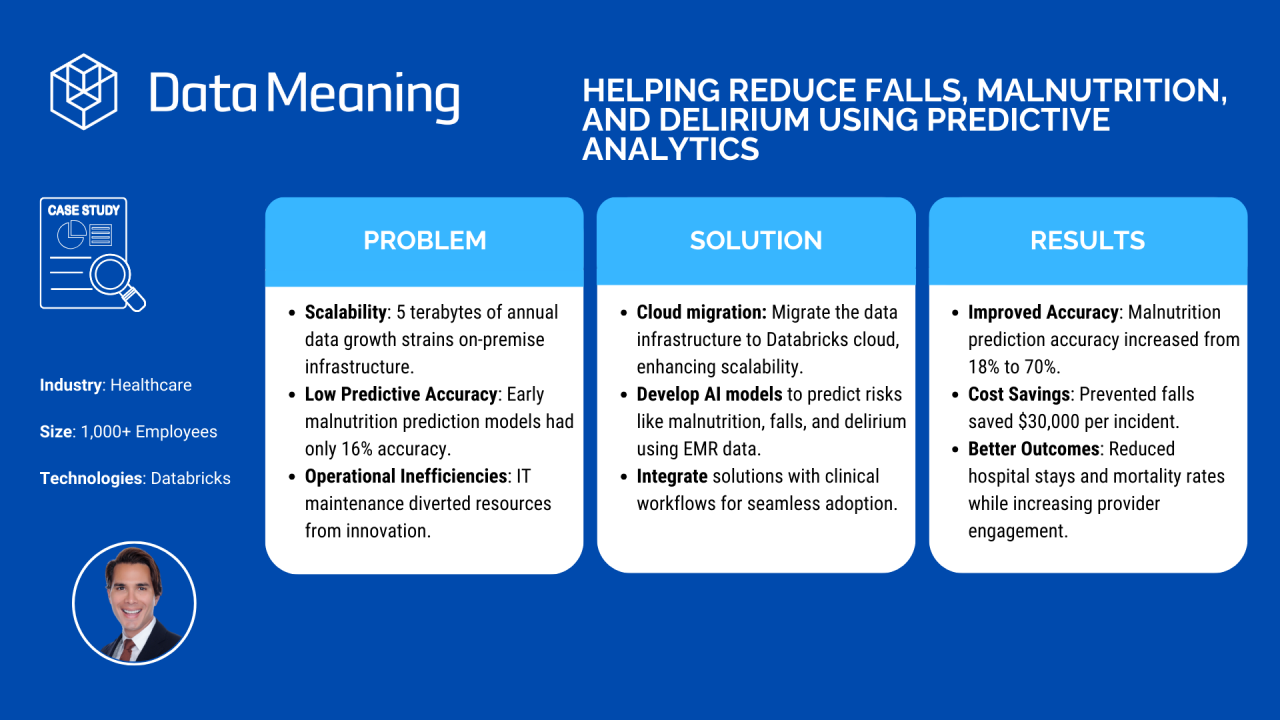
Improving Patient Outcomes with AI: Helping Reduce Falls, Malnutrition, and Delirium Using Predictive Analytics
A prominent healthcare provider partnered with Data Meaning to revolutionize its use of AI and data science in healthcare, aiming to significantly enhance patient outcomes and streamline clinical operations. Since the launch of their Clinical Data Science (CDS) system, the healthcare provider has been dedicated to leveraging advanced analytics and machine learning to address key…
-
Building AI Readiness: A Strategic Roadmap for Your Business
In today’s competitive landscape, Artificial Intelligence (AI) isn’t just a buzzword—it’s the key to driving innovation, operational excellence, and long-term growth. As organizations across industries adopt AI to solve complex challenges, the real question is: Are you ready to implement AI at scale? At Data Meaning, we’ve helped businesses across sectors like retail, financial services,…

-
Scaling Analytics Workstreams: Best Practices for Growth
As organizations grow, the need for data-driven decision-making increases. This leads to a need to scale analytics workstreams. Scaling analytics workstreams can be a challenge, but it is essential for organizations that want to remain competitive and successful. Here are some best practices for scaling analytics workstreams: Here are some additional tips for scaling analytics…

-
Data Governance and Analytics: Building a Stronger Foundation for Growth
In the data-driven age, the ability to harness the full potential of your data is a defining factor for success. For many organizations, this journey begins with the convergence of data governance and analytics—a synergy that not only safeguards data but also fuels growth and innovation. The Power of Data Governance Data governance is often…

-
Beyond Compliance: How Data Governance Can Drive Business Value
In today’s data-centric world, data governance is often seen through the lens of compliance—a necessary checkbox to meet regulatory requirements. However, this limited perspective overlooks a more profound truth: Data governance, when done right, is a strategic asset that can propel your business to new heights. The Compliance Imperative Data governance, in its early stages,…

-
The Evolution of Data Governance: Trends to Watch in 2023
As we step into the future, the landscape of data governance continues to evolve at an exhilarating pace. The role of data governance in ensuring data quality, security, and compliance has never been more critical. Let’s explore the trends that will shape the data governance landscape in 2023 and beyond. Join the Conversation Let’s engage…

-
Mastering Alteryx Gallery: Best Practices for Workflow Sharing and Collaboration
Alteryx Gallery, a dynamic platform for sharing and collaborating on workflows, has become an indispensable tool for organizations seeking to maximize the value of their data. However, to fully harness the power of Alteryx Gallery, it’s crucial to adopt best practices that streamline workflow sharing and collaboration. In this article, we’re delving into the world…

-
Alteryx Designer Tips: Shortcuts and Techniques for Faster Workflows
Alteryx Designer, a powerful tool for data preparation and analytics, offers a plethora of features that can significantly speed up your workflows. But to truly maximize its potential, it’s essential to harness shortcuts and techniques that streamline your processes. In this article, we’re diving into Alteryx Designer’s time-saving tips and techniques, empowering you to work…

-
Data Sharing in Snowflake – A Deep Dive into Collaboration Features
Snowflake, a cloud data platform, offers a wealth of features designed to facilitate data sharing and collaboration across organizations. However, to harness the full potential of Snowflake, it’s crucial to understand the intricacies of its collaboration capabilities. In this article, we embark on a deep dive into Snowflake’s data sharing features, shedding light on how…

-
Databricks Best Practices – Optimizing Data Workloads and Scalability
Databricks is a unified analytics platform that helps businesses of all sizes to build, deploy, and manage data pipelines and analytics workflows. It provides a wide range of features and capabilities, including Apache Spark, Delta Lake, and machine learning. To optimize data workloads and scalability on Databricks, it is important to follow a number of…

-
Power BI Service Updates: What Admins Need to Know
Microsoft is constantly updating the Power BI service with new features and improvements. As an admin, it is important to stay up-to-date on the latest changes so that you can keep your organization’s Power BI environment running smoothly and securely. Here are some of the most important Power BI service updates that admins need to…

-
Data Governance and Compliance – The Hidden Costs of Mundane Data Tasks
In the realm of data governance and compliance, there’s more to the story than meets the eye. While data governance is essential for maintaining data accuracy, security, and compliance, there’s a hidden cost associated with the mundane, repetitive data tasks that often go unnoticed. At Data Meaning, we believe that these hidden costs deserve attention,…

-
Tableau Online Admin Insights: Keeping Your Dashboards Running Smoothly
Tableau Online Admin Insights is a powerful tool that helps you keep your dashboards running smoothly. It provides you with a rich data set that you can use to measure site activity and content adoption, identify and troubleshoot performance issues, and make informed decisions about how to improve your site’s performance and usability. Here are…

-
How to Round Numbers to the Nearest Hundred in Alteryx: A Step-by-Step Guide
Rounding numbers is an essential part of data preparation, especially when standardizing datasets for reporting and analysis. Whether you’re working on financial data, survey results, or operational metrics, ensuring uniformity can make your insights more impactful and easier to interpret. In our latest video, we dive into how Alteryx simplifies this process with its powerful…
-
How to Save and Package Alteryx Workflows: A Step-by-Step Guide
When working with Alteryx, efficient workflow management is a must. Whether you’re sharing with a team, archiving your work, or preparing for collaboration, knowing how to save and package your workflows is essential. Luckily, Alteryx makes this process simple and intuitive. In the embedded video below, we walk you through the steps to save your…

-
How to Save Excel as PDF in Alteryx
In today’s fast-paced business environment, presenting data in a professional and accessible format is crucial. Whether you’re creating a polished report for stakeholders or need to streamline your workflows, Alteryx offers a seamless solution for converting Excel data into well-formatted PDFs. In our latest video tutorial, we dive into how you can leverage Alteryx’s powerful…

-
How to Round Numbers in Alteryx: A Step-by-Step Video Guide
Rounding numbers is an essential part of data processing, especially when working with precise calculations or simplifying large datasets. Whether you’re refining decimals or working with whole numbers, knowing how to round effectively in Alteryx can save time and improve accuracy. In this blog post, we’ll introduce you to the simple yet powerful Round Formula…

-
How to Rename Columns in Alteryx: A Simple Guide for Beginners and Experts
When working with Alteryx, one of the most common tasks you’ll encounter is renaming columns in your datasets. Whether you’re organizing messy data or preparing it for analysis, knowing the right tools to use can save you time and streamline your workflow. In this blog post, we’ll introduce you to two methods for renaming columns…

-
How to Remove Rows in Alteryx
Alteryx is an essential tool for data professionals, offering powerful features to simplify complex workflows. One common challenge when managing datasets is filtering out unnecessary rows or isolating specific ones for further analysis. Whether you’re preparing data for a report or refining a dataset for machine learning, knowing how to remove rows efficiently can save…

-
How to Remove Leading Zeros from a String Field in Alteryx
When working with data, leading zeros in string fields can cause unexpected formatting issues or disrupt data analysis processes. Whether you’re dealing with IDs, phone numbers, or currency fields, cleaning up this data efficiently is crucial for maintaining accuracy and consistency. In this post, we’ll walk you through two powerful methods to remove leading zeros…
-
How to Remove Duplicates in Alteryx: A Step-by-Step Guide
Data preparation is a cornerstone of effective data analytics, and managing duplicate data is a critical part of this process. Duplicate entries can distort your insights and lead to inaccurate results. If you’re an Alteryx user, you’re in luck—removing duplicates is both simple and efficient using the Unique Tool. In this blog post, we’ll introduce…

-
How to Replace Excel’s VLOOKUP with Alteryx
Are you tired of dealing with Excel’s clunky VLOOKUP formula? While Excel’s functionality is widely appreciated, it can sometimes feel restrictive, especially when managing large datasets or customizing how columns are merged. Fortunately, Alteryx provides smarter, faster, and more flexible alternatives for data joins. In this post, we’ll introduce two powerful ways to perform a…

-
How to Concatenate Data in Alteryx: A Simple Guide for Beginners
Concatenating data can often feel like a complicated task, especially when using tools like Excel. But with Alteryx, merging data fields is easier than you might think! Whether you’re a beginner or a seasoned data analyst, Alteryx’s intuitive design allows you to concatenate text, numbers, and special characters in just a few clicks. In this…

-
How to Combine Excel Files in Alteryx: A Step-by-Step Guide
In today’s data-driven world, working with multiple datasets is a common challenge. One of the most frequent tasks data professionals face is combining data from different Excel files. While this may sound simple, it becomes more complicated when the files have different schemas. Fortunately, Alteryx offers powerful tools that make this process seamless and efficient.…
-
How to Change Date Formats in Alteryx: A Step-by-Step Guide for Beginners
Working with dates in Alteryx is a common task for data analysts, and knowing how to properly format them can significantly improve the readability and utility of your data. In this post, we dive into how you can change and customize date formats in Alteryx using two easy-to-learn methods: the Formula Tool and the DateTime…

-
How to Decode URLs in Alteryx: A Step-by-Step Guide
When working with data, especially URLs, one common challenge is dealing with special characters like spaces, ampersands, and question marks. These characters are often encoded to ensure they are transmitted correctly across the web. But what happens when you need to reverse the encoding? This is where a URL decoder comes in handy, and Alteryx…
-
How to Easily Convert Time Zones in Alteryx: Step-by-Step Guide with DayTime UDC
If you’re working with data across multiple time zones, keeping everything synchronized can be a real challenge. Daylight saving time (DST) shifts and differing time zone offsets can throw a wrench into your data analysis. Fortunately, Alteryx provides a straightforward solution to this common problem with its DayTime UDC formula, which helps you convert local…
-
How Proper Enablement Can Boost Retention
In the competitive landscape of today’s business world, retaining top talent is a priority for every organization. Employee attrition not only impacts productivity but also incurs significant costs in recruitment and training. However, there’s a powerful solution often overlooked – proper enablement. In this article, we’ll explore how enabling your workforce can be the key…

-
How to Calculate Standard Deviation in Alteryx Designer: A Step-by-Step Guide
In data analysis, understanding the variation within your data set is essential. Standard deviation, a key statistical metric, helps quantify this spread by showing how much individual data points deviate from the average or mean. A low standard deviation indicates that data points are close to the mean, while a high standard deviation signals a…
-
How to Use Alteryx Predictive Tools for Data Analysis and Forecasting
Predictive analytics has become a critical component of data-driven decision-making, empowering businesses to forecast trends, segment audiences, and optimize operations. Alteryx, with its intuitive interface and powerful tools, provides a flexible environment for performing predictive analysis, whether you’re a beginner or a seasoned data scientist. In this video, we delve into the predictive capabilities of…

-
How to Connect Outlook 365 to Alteryx: Streamline Emails, Attachments, and Calendars
In today’s fast-paced digital world, efficiency and seamless data integration are key. For teams that rely heavily on email communications, calendar events, and attachments, integrating data from Outlook 365 into Alteryx workflows can be a game-changer. With the Outlook 365 Connector tool available in the Alteryx Marketplace, users can streamline their data retrieval, automate workflows,…
-
How to Use Regex in Alteryx Designer for Powerful Data Parsing
In the world of data analysis, parsing and cleaning text data can often be one of the most challenging tasks. For Alteryx users, Regex (regular expressions) is a powerful tool for handling complex data parsing and extraction, streamlining processes that would otherwise be time-consuming. But if you’re new to Regex, it can seem a bit…

-
How to Manage Time Zones in Alteryx with DateTime UDC Formula
If you’re working with Alteryx Designer and need to handle multiple time zones effectively, the DateTime UDC formula is here to help. This powerful feature converts local dates and times to UTC (Coordinated Universal Time), ensuring consistency and eliminating the challenges associated with daylight saving time adjustments and time zone discrepancies. In the video below,…
-
How to Format Dates in Alteryx: A Guide to Using the DateTime Tool
When working with diverse data sets, one common hurdle analysts face is managing and standardizing date formats. Without consistency, data analysis can become challenging, often leading to errors and compatibility issues with downstream tools like visualization and reporting software. Alteryx Designer offers a powerful solution to this problem with its DateTime tool, allowing users to…

-
Mastering Alteryx Date Calculations: How to Track, Measure, and Analyze Data Effortlessly
In data analytics, time is a critical factor—whether it’s tracking deadlines, measuring intervals, or analyzing historical patterns. For data professionals working with time-sensitive metrics, Alteryx provides robust DateTime functions that make date calculations straightforward. This video dives into Alteryx’s DateTime features, showing how easy it is to calculate differences, add or subtract specific time periods,…

-
Snowflake Enablement: From Data Warehousing to Data-Driven Insights
In the ever-evolving landscape of data management, Snowflake has emerged as a game-changer, providing a cloud data platform that offers unparalleled flexibility, scalability, and performance. However, the true potential of Snowflake is fully realized when organizations invest in proper enablement and training. In this article, we’ll delve into why Snowflake enablement is essential, how it…

-
How to Use the Alteryx Summarize Tool for Data Aggregation
Efficient data analysis is essential in today’s data-driven world, and Alteryx Designer offers powerful tools to make this process seamless. One of these tools, the Summarize Tool, allows users to aggregate, condense, and organize data for reporting and dashboarding with ease. Whether you’re working on large datasets or need to create detailed summaries, the Summarize…
-
How to Extract and Automate Data from PDFs with Alteryx PDF to Text Tool
Working with PDF files in data workflows can be challenging, especially when you need to extract specific text for deeper analysis. Alteryx’s PDF to Text Tool, part of the Intelligence Suite, is designed to make this process seamless. Ideal for handling text-based PDFs like invoices, reports, and forms, this tool enables users to automate data…
-
Unlocking the Potential of Alteryx: How Proper Enablement Can Transform Your Analytics Workflow
Alteryx, a leading analytics platform, empowers organizations to harness the full potential of their data. However, to truly unlock its transformative capabilities, it’s essential to invest in proper enablement. In this article, we explore how proper enablement can revolutionize your analytics workflow with Alteryx, elevating your organization’s data-driven journey. Enablement is the process of providing…

-
Analytics in a Post-COVID World – Lessons Learned and Strategies Ahead
The global business landscape has undergone a seismic shift over the past few years, with the COVID-19 pandemic serving as a catalyst for change. Organizations across industries have had to adapt rapidly, and data analytics has played a pivotal role in guiding decision-making during these uncertain times. In this article, we’ll explore the lessons learned…

-
SaaS vs On-Premises Analytics – Weighing the Pros and Cons
In the realm of analytics, one of the key decisions organizations face is whether to opt for Software as a Service (SaaS) solutions or stick with traditional on-premises software. Both approaches have their merits, but how do you choose what’s right for your business? In this article, we’ll explore the pros and cons of each…

-
Data and Analytics Talent: Navigating the Skills Gap in the Industry
Data and analytics talent is in high demand, and the skills gap in the industry is only widening. According to a recent report by McKinsey & Company, the global shortage of data and analytics talent is expected to reach 85 million by 2030. This shortage is being driven by a number of factors, including: The…

-
The Art of Data Storytelling – Turning Insights into Actionable Narratives
In the era of data abundance, the ability to tell compelling stories with data is becoming a critical skill. Data alone doesn’t drive change; it’s the stories we weave around it that inspire action and transformation. The Power of Narrative Humans are hardwired to respond to stories. Narratives engage our emotions, making data relatable and…

-
Cybersecurity in Analytics – Protecting Data in an Interconnected World
In an increasingly interconnected world, data is more valuable than ever before. This makes data analytics a critical tool for businesses of all sizes. However, with great power comes great responsibility. Organizations that collect and analyze data must take steps to protect it from cyber threats. There are a number of things that organizations can…

-
Data Monetization – Turning Data Assets into Revenue Streams
Data has become one of the most valuable assets for businesses across industries. From customer behavior insights to market trends and operational efficiencies, data holds the key to making informed decisions and gaining a competitive edge. But how can organizations turn their data assets into revenue streams? This can be done in a number of…

-
The Evolution of Data Warehousing – Trends Shaping the Future
In the ever-evolving landscape of data analytics, one of the key players that continually adapts to meet the demands of businesses is data warehousing. Over the years, data warehousing has transformed from a static repository of historical data into a dynamic and strategic asset that empowers organizations to make data-driven decisions. In this article, we’ll…

-
Building a Data-Driven Culture: Strategies for Organizational Transformation
In today’s data-driven world, organizations that want to succeed need to build a culture where data is used to inform decision-making at all levels. A data-driven culture is one where everyone in the organization understands the importance of data and is able to use it to improve their work. Building a data-driven culture is not…

-
Choosing the Right Data Transformation Tool for Your Cloud Strategy
In today’s fast-paced business landscape, embracing the cloud has become a strategic imperative. It’s no longer a question of if, but when and how to migrate to the cloud. However, one critical aspect often overlooked is choosing the right data transformation tool to make the most of your cloud strategy. There are a number of…

-
Empowering Your Team – The Link Between Employee Morale and Enablement
In the dynamic world of modern business, employee morale is the cornerstone of success. High morale leads to increased productivity, innovation, and, ultimately, better business outcomes. One often underestimated driver of employee morale is enablement—the process of providing employees with the tools, knowledge, and support they need to excel. In this article, we’ll explore the…

-
Alation´s Data Catalog – Enabling Effective Data Discovery and Collaboration
In the era of data-driven decision-making, organizations need a clear and efficient way to access, understand, and collaborate on their data assets. Enter Alation’s Data Catalog—a powerful tool that enables effective data discovery and collaboration. In this article, we’ll delve into the role of Alation’s Data Catalog and how enablement can accelerate its adoption, ultimately…